6 August 2026
The Lessons Are in English. Everything Else Follows From That.
A private education that would cost a mid-sized German salary costs a modest monthly figure here, taught in a language your child already speaks. The trade-offs are real, and they are not the ones people expect.
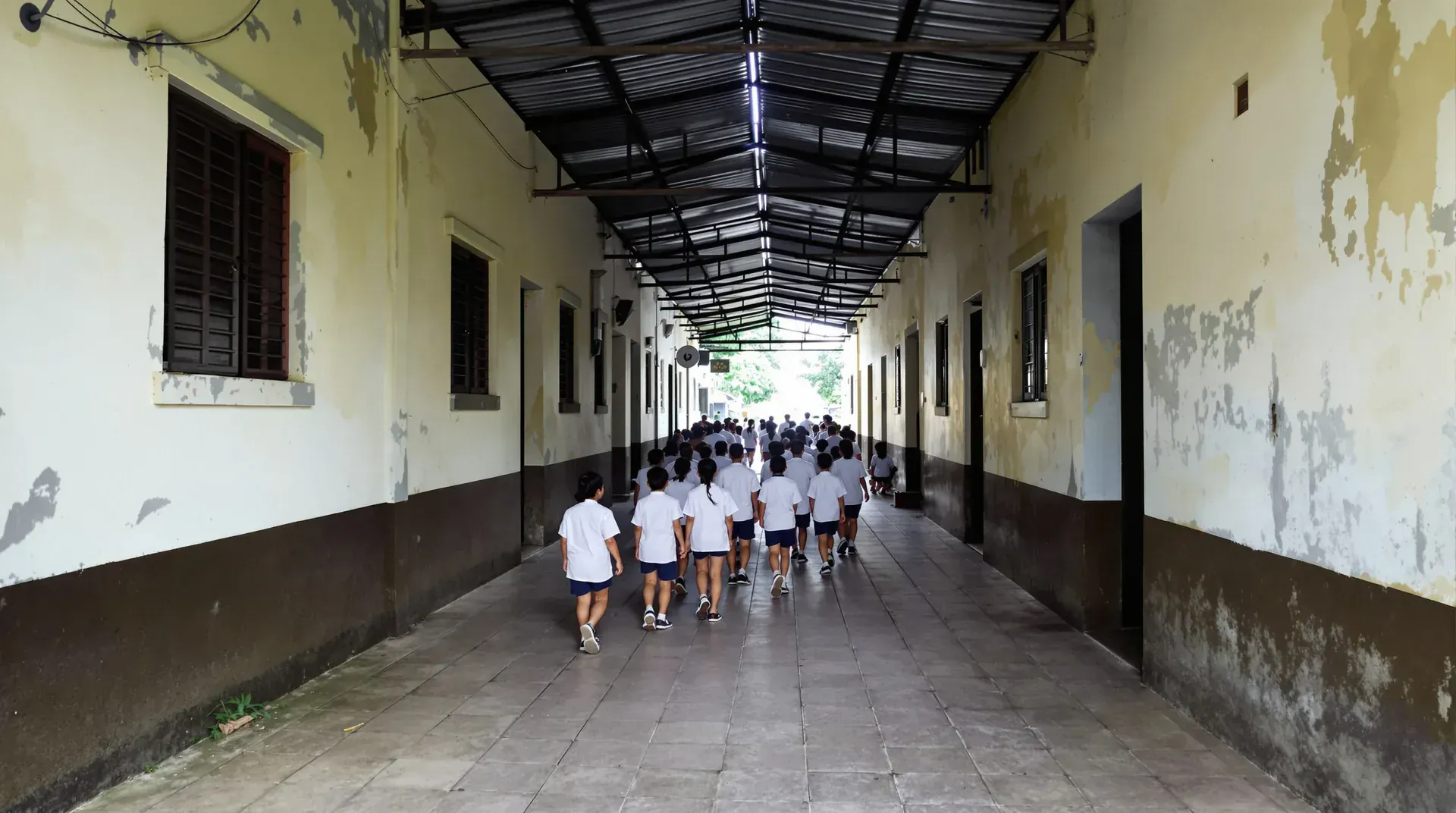
The question arrives late in most relocation plans, and it should arrive first.
Adults can adapt to almost anything. A twelve-year-old cannot be relocated into a school system that does not fit them and simply be told it will be fine. So of all the reasons a move to the Philippines works or does not work, this is the one that decides most often, and it is the one where the answer is unexpectedly good.
The single biggest fact: everything is in English
Philippine education is conducted substantially in English. Textbooks are in English. Instruction from the middle years upward is in English. University is in English. This is not an international-school feature, it is the national norm, and it is the reason the country exports professionals to every health system on earth.
For a foreign family, the consequence is enormous. Your child does not lose two years to language acquisition. A ten-year-old from Dublin, Sydney or Manchester walks into a Davao classroom and can follow the lesson on day one. A child from Germany, Austria or Switzerland with school English will struggle for a term and then be fine, which is a completely different proposition from being dropped into a Thai or Vietnamese system.
Filipino, and in this region Bisaya, will be present as subjects and as playground language. Children pick both up at a speed that is faintly insulting to their parents.
How the system is structured
The Philippines runs a K to 12 structure: kindergarten, six years of elementary, four years of junior high school, and two years of senior high school with a chosen track. Senior high school ends at eighteen, which aligns reasonably with European and Australian expectations, and university follows.
The academic calendar has moved around since 2020 and has been pulled between an August start and the traditional June start. Check the current Department of Education calendar for the year you are arriving, because it affects when enrolment windows open and it has genuinely caught families out.
What is actually available in Davao
Three broad tiers, and the price gaps between them are large.
Public schools are free, they are where the overwhelming majority of Filipino children are educated, and class sizes are large. Very few foreign families choose this route, and those who do usually have a Filipino parent and a specific community reason.
Private Filipino schools are where most foreign families land, and this tier is broader and better than outsiders expect. Davao has long-established institutions with real academic reputations, including Catholic and Jesuit foundations with attached grade and high schools, and a range of independent private academies across the city. Ateneo de Davao is the best known of the university-linked institutions.
Tuition in this tier varies widely by school and year level, but the honest framing is this: a good private education in Davao costs, per year, roughly what a month of the equivalent costs in Western Europe. Then add uniforms, books, transport, activity fees, and the various contributions that are a permanent feature of Philippine school life.
International-curriculum schools exist in Davao, offering Cambridge and similar programmes, and they cost multiples of the private Filipino tier. They are the right answer for families who expect to move again and need portable qualifications, and they are an expensive answer for families who are staying.
Homeschooling, which is legal, established, and supported by accredited providers in the Philippines, is used by a meaningful number of foreign families here. It suits people who are mobile, who want to keep a home-country curriculum, or who arrived mid-year. The obvious cost is social: a child educated at home in a country where they are already visibly different needs a deliberate plan for friendship, and the families who do this well build that plan first.
The costs nobody puts in the brochure
Philippine school life comes with a rhythm of small expenses that adds up and that surprises Northern Europeans used to a state system.
- •Uniforms, including a separate PE uniform, replaced as children grow.
- •Books and modules, bought rather than lent.
- •Projects. Filipino schools set a great many of them, and they involve materials, printing and, occasionally, a parent up at midnight with a glue gun.
- •Events. Foundation days, recognition days, Christmas programmes, field trips. Attendance is expected and so are contributions.
- •Graduation. This is a genuinely large cultural event at multiple stages of schooling, with a photographer, a venue, and in many cases sponsors.
None of it is expensive by Western standards. All of it is constant, and it belongs in the household budget rather than as a surprise, alongside everything else in the cost-of-living breakdown.
What actually changes for the child
The academic content is not the adjustment. Here is what is.
School is warmer and more formal at the same time. Teachers are addressed with respect that would look old-fashioned in Berlin. There is more ceremony, more prayer in Catholic schools, more singing, and more group identity. Children generally love this. Parents from secular Northern European backgrounds sometimes need a moment.
Discipline and expectation are different. Rote learning has a larger place than in progressive European systems, and independent critical argument has a smaller one. Whether that matters to you depends on what you want from a school and how long you intend to stay.
Your child will be visible. In a Davao classroom a Western child is interesting, and interest here is warm rather than hostile. Most children handle this well and some find it exhausting for the first term.
Filipino children are, by international standards, extraordinarily kind to newcomers. This is the part every foreign parent reports and none expected. The social landing is softer here than almost anywhere.
The question behind the question
If you are moving with school-age children, you are not really asking about tuition. You are asking whether this is a place a family works.
The honest answer from a city like Davao is that the day is better here for a child than in most Western cities. Outdoor life is year round. The sea is twenty minutes away. Space costs a fraction of what it costs at home, which means a real garden rather than a balcony. Households have help, which means parents have time, in the way described in the househelp piece. And the safety picture, which is the thing every parent asks about first, is genuinely and measurably better than the reputation, as set out in why Davao is safer than you think.
What you give up is a familiar credential path, proximity to grandparents, and the assumption that university will be around the corner. Those are real losses and they should be counted.
Practical sequencing
Visit schools before you commit to a neighbourhood, not after. School run distance in a city with traffic is a daily tax, and the neighbourhood guide is written with that in mind.
Bring apostilled (or, from Germany, Finland and Greece, legalised) school records, birth certificates and immunisation records from home. Getting these afterwards, from abroad, is exactly the miserable exercise described in shipping your life.
And settle the visa question for the children early. Dependants can be included on most of the routes, and the mechanics differ between them: the SRRV has a dependant structure with its own fees, and the 13A has its own logic. The comparison is in three routes, one of them yours.
If you want to talk this through with people who have children in Davao schools themselves, that is our team.
Ready to build your Davao base?
Order services directly, or book a call with Tim to discuss your situation first.