Most people discover the SRRV the hard way: after their third tourist visa extension, standing in line at the Bureau of Immigration, wondering why they're still a visitor in a country they already live in.
The Special Resident Retiree's Visa is the answer. Issued under the Philippine Retirement Authority (PRA) programme, it grants permanent residency with multiple-entry privileges: no more extensions, no exit clearances, no annual BI report, no onward-ticket questions at check-in. You land, you're home.
And despite the name, you don't need to be retired. Since the September 2025 reform, anyone aged 40 or above who meets the deposit requirements can apply. You can keep working remotely, running your business abroad, or doing nothing at all. The visa doesn't care.
What Changed in September 2025
The PRA restructured the entire programme: the "Expanded SRRV Program". If you researched the SRRV before late 2025, most of what you read is outdated:
- •Minimum age lowered to 40 for all applicants (previously 50, regardless of pension).
- •Only two categories remain: SRRV Classic and SRRV Courtesy. The Smile and Human Touch categories were abolished for new applicants.
- •New deposit tiers for the 40–49 bracket, higher than the 50+ tiers.
- •Bureau of Immigration clearance is now mandatory for every applicant.
- •Renewals moved to a 2-year cycle instead of annual.
Existing SRRV holders (including Smile holders) keep their visas under the old terms. The changes apply to new applications only.
SRRV Classic: Deposit Requirements 2026
The Classic category is the route for ordinary foreign nationals. Your required deposit depends on two things: your age bracket and whether you receive a lifetime pension (state or private, from USD 800 per month for a single applicant, documented by your pension papers).
| Age 40–49 | Age 50+ | |
|---|---|---|
| With pension | USD 25,000 | USD 15,000 |
| Without pension | USD 50,000 | USD 30,000 |
No pension? Build one. The gap between the tiers is pure capital: USD 25,000 between 40 and 49, USD 15,000 from 50. Without a pension statement you still don't have to take the expensive tier. Your own US LLC can award you a documented company pension, lawyer-drafted and apostilled; the SRRV is issued on the pension documents alone, with no months of payments to sit through first. The same pension later opens Panama, the UAE or Turkey. → The pension-plan LLC
The deposit goes into a PRA-accredited Philippine bank in your name as a time deposit. It stays there for as long as you hold the visa. It's not a fee, it's your money, and it comes back if you ever cancel the SRRV. The bank issues a certification that forms part of your application.
Pensioners must document their entitlement with apostilled (or legalised) proof showing the monthly amount. Documents from Germany, Finland or Greece cannot be apostilled for the Philippines: those countries objected to the Philippines' accession to the Apostille Convention, so their documents need consular legalisation instead (authentication at home, then by the Philippine embassy or consulate).
SRRV Courtesy
The Courtesy category (USD 1,500 deposit) is limited to special groups: former Filipino citizens, retired diplomats and officers of international organisations, and retired foreign military personnel. If that's you, the economics are trivially good, but for most readers, Classic is the relevant track.
What the SRRV Actually Gets You
- •Permanent residency with unlimited multiple entry and exit
- •No annual report at the Bureau of Immigration: The PRA handles your compliance
- •No exit clearance (ECC) when leaving the country
- •Exemption from standard ACR I-Card procedures: You carry the PRA's SRRV card instead
- •Tax position: As a resident alien, you're taxed in the Philippines only on Philippine-source income. Your foreign pension, your foreign dividends, your remote-work income from abroad: generally outside the Philippine tax net. (The full picture, including your home-country side, is on our tax page.)
- •Dependents included: spouse and children under 21 can be added (USD 300 fee per dependent; additional deposit may apply beyond two dependents)
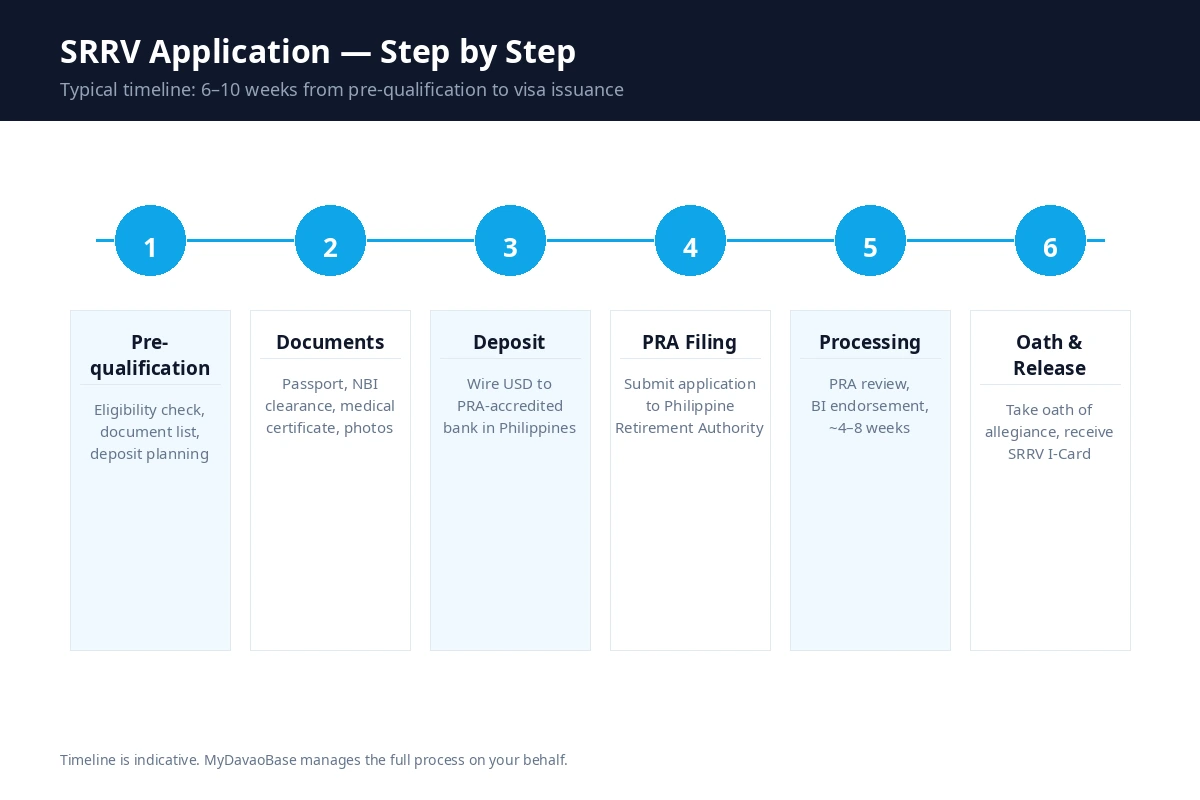
The Application Process
Plan around 30 days in the Philippines for your application trip. From the day you book, Tim personally guides you through every step, and in Davao we accompany you to every single appointment.
- 1
Pre-qualification
We review your age bracket, pension status, nationality and documents before anything is filed. This is where most DIY applications go wrong: A missing or wrong authentication costs you a month.
- 2
Document preparation
Passport, police clearance from your home country (apostilled, or legalised if issued in Germany, Finland or Greece), medical certificate, pension proof if applicable. NBI clearance if you've been in the Philippines over 30 days.
- 3
Deposit remittance
Wire the deposit to a PRA-accredited bank. The bank certification is issued once funds clear.
- 4
Filing with the PRA
Application, fees (USD 1,500 principal), and the now-mandatory BI clearance.
- 5
Processing
Typically several weeks with complete documents. Manila head office and satellite offices both process applications.
- 6
Oath and release
The PRA administers the oath and releases your SRRV documentation and card. Done, permanently.
The Full Cost Picture
The deposit dominates the conversation, but it isn't a cost: It's your capital, parked. The actual costs of holding an SRRV are modest and worth knowing upfront:
- •Application fee: USD 1,500 for the principal applicant, one-time, non-refundable; USD 300 per dependent.
- •Annual PRA fee: a few hundred dollars per year covering the principal and first dependents: This is the ongoing price of skipping every BI queue for the rest of your life, and since the reform it's handled on a 2-year renewal cycle.
- •Document costs at home: apostilled (or legalised) police clearance and (for pensioners) pension proof: typically USD 100–300 total depending on your country's process, plus courier time. Budget the *time* more than the money: document authentication is the single most common cause of delay.
- •Medical certificate and photos: trivial amounts, obtainable in Davao.
- •Bank charges: the PRA-accredited banks apply standard account fees on the time deposit; interest rates on USD deposits are low. Treat the deposit as a residency instrument, not a yield product.
Compare that to the alternative most people are actually living: tourist extension fees every 1–2 months for up to 36 months, ECC fees on departures, and the recurring half-day at the BI office. Over a three-year horizon, the SRRV's running costs are comparable, and at the end of it you hold permanent status instead of a stack of extension receipts.
Five Mistakes That Delay SRRV Applications
After enough applications, the failure patterns repeat:
- 1
Authentication sequencing
Police clearances have validity windows. Get the apostille (or legalisation) immediately after issuance, and don't obtain the clearance months before you intend to file.
- 2
Pension proof that doesn't show the monthly amount
A letter confirming you *receive* a pension isn't enough; the PRA wants the documented monthly entitlement. Get the granular statement authenticated, not the summary letter.
- 3
Wiring the deposit to the wrong account type
The deposit must land at a PRA-accredited bank under the correct account designation before the certification can be issued. A normal savings account at the same bank doesn't count.
- 4
Assuming the old categories still exist
Applications prepared against pre-2025 guides (Smile category, 50+ threshold, old deposit levels) get bounced. Everything on this page reflects the post-September-2025 rules.
- 5
Ignoring the BI clearance
It's mandatory for every applicant since the reform. If you've had overstays or visa irregularities in the Philippines before, resolve them *before* filing, not during.
Every one of these is avoidable with sequencing, which is most of what you're paying an agent for.
SRRV vs the Alternatives
Tourist visa extensions work for up to 36 months, but you remain a visitor: extensions, ECC on departure, and no path to anything permanent. Fine for a trial year; wrong for a base. → Tourist Visa Extension guide
The 13A marriage visa requires a Filipino spouse. If you have one, it's cheaper. If you don't, it's irrelevant, and unlike the 13A, the SRRV stands entirely on your own qualification. → 13A guide
The SIRV is the investor's route (USD 75,000 into qualifying Philippine equities). More capital, more moving parts, but the deposit works as an actual investment. → SIRV guide
Under 40 and not married? The Quota Visa is the fourth door: full Section 13 permanent residency without a spouse and without the age-40 floor, in exchange for a USD 100,000 capacity test and only 50 slots per nationality each year. → Quota Visa guide
For most people over 40 who want the Philippines as a long-term base, the SRRV wins on simplicity: one deposit, one application, permanent result.
Go deeper on the SRRV
Three focused guides for the details:
- •What the SRRV actually costs: deposit tiers, fees, and the deposit-insurance truth most agencies skip.
- •The complete requirements checklist: documents, clearances, and the process step by step.
- •SRRV Smile is gone: what the 2025 restructure changed and what replaced it.
Frequently Asked Questions
Do I have to be retired to get the SRRV?
No. Despite the name, there is no requirement to have stopped working. You need to meet the minimum age of 40 and the deposit requirements for your category.
Is the SRRV deposit a fee?
No. It's a time deposit in your name at a PRA-accredited Philippine bank. It remains your money and is returned if you cancel the visa.
Can I convert the deposit into property?
Deposit conversion into qualifying investments (such as a condominium purchase) has historically been possible under the Classic category subject to PRA conditions. The post-2025 rules on conversion should be confirmed with the PRA at the time of application. We check this as part of pre-qualification.
What is the minimum age in 2026?
40, for all applicants, since the September 2025 reform. Deposits are higher for the 40–49 bracket than for 50+.
How long does the application take?
With complete documents, typically 30–45 working days end to end, including deposit clearance and BI clearance. Incomplete or wrong document authentication is the most common cause of delay.
Does the SRRV affect my taxes?
As an SRRV holder you're a resident alien for Philippine tax purposes: taxed only on Philippine-source income. Your home-country obligations depend on your residency status there and any applicable tax treaty. See our tax overview for the full picture.
Can my family come with me?
Yes. Your spouse and unmarried children under 21 can be included as dependents for USD 300 each.
Our Commitment to You
The MyDavaoBase 7-Star Client Success Guarantee
Every client. Every package. No exceptions.