
The Philippine residency system has a door that most people never hear about. It doesn't require a Filipino spouse. It doesn't require you to be 40. It doesn't park your money in a locked deposit for as long as you hold the visa. It grants full permanent residency, the same Section 13 immigrant status a foreign spouse receives, and it has existed since 1940.
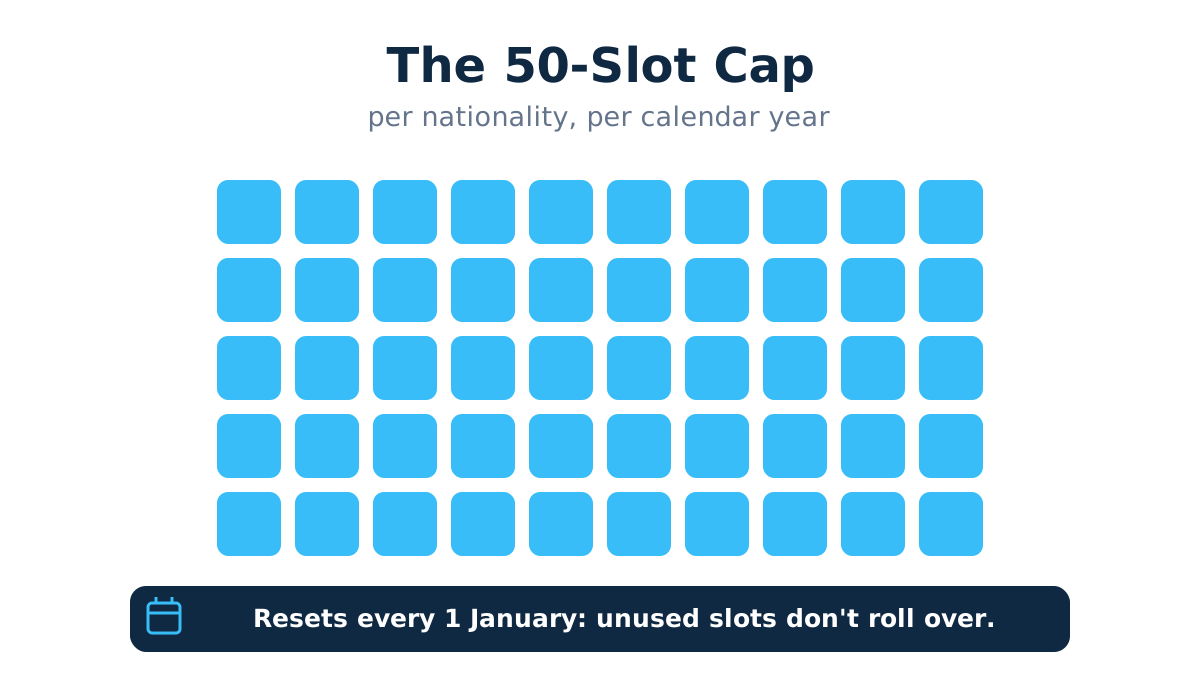
The catch is in the name. The Quota Visa is limited by law to 50 applicants per nationality per calendar year. Unused slots don't roll over. On 1 January the counter resets, and the race starts again.
If you qualify, this is arguably the cleanest permanent residency the Philippines offers. Here is how it works in 2026, including what changed after the Bureau of Immigration's 2025 overhaul.
What the Quota Visa Actually Is
The Quota Visa is issued under Section 13 of the Philippine Immigration Act of 1940 (Commonwealth Act No. 613). While the better-known 13(a) covers foreign spouses of Filipino citizens, the quota category covers foreigners admitted on their own merits: people whose qualifications or capital are considered beneficial to the Philippines.
Approved applicants become permanent residents. That means:
- •Permanent residency with unlimited multiple entry and exit, no extensions, ever
- •An ACR I-Card as your official residency ID
- •The right to live, study and do business in the Philippines (local employment additionally requires an Alien Employment Permit, like for other resident aliens)
- •Resident alien tax status once you meet the presence rules (details below and on our tax page)
- •A path that counts toward naturalization if citizenship ever interests you
- •One recurring obligation: the Annual Report at the BI between 1 January and 1 March each year
Unlike the SRRV, there is no retirement authority and no deposit that must remain locked with a Philippine bank for the life of the visa. Unlike the SIRV, your capital does not have to sit in listed shares or government bonds. The quota visa is administered directly by the Bureau of Immigration, and once granted, it is yours to keep, subject to the ordinary rules that apply to any permanent resident.
Who Qualifies
Three tests, all set by the statute and BI practice:
1. Nationality with reciprocity. You must be a citizen of a country that has diplomatic relations with the Philippines and grants Filipinos comparable immigration privileges. Most Western nationalities, including US, UK and EU citizens, are routinely accepted under this principle.
2. Qualifications or capital that benefit the Philippines. The law favors applicants with high educational attainment, technical expertise, professional standing or business ability. In practice, the financial test below carries most of the weight, but a strong professional profile (degrees, certifications, a track record) materially helps your file at the hearing stage.
3. Financial capacity: the USD 100,000 rule. Since the 2025 reform, the BI's own documentary checklist requires proof of one of the following:
- •A bank certification of inward remittance of at least USD 100,000 (or equivalent in another foreign currency) into the Philippines, or
- •Documents evidencing ownership or purchase of a condominium unit, or
- •Documents showing ownership of or investment in an existing Philippine corporation, enterprise or business amounting to USD 100,000
Note what this is and isn't. The remittance proves capacity and commitment; it is not a deposit locked in a prescribed instrument. Money remitted into your own Philippine account, a condo purchase, or an existing business stake can satisfy the test. If you were planning to buy a condominium in Davao anyway, the same purchase can carry your visa application. Our property galleries show what that money buys here.
What Changed in 2025
If you researched the quota visa before 2025, most of what you read is outdated:
- •The BI suspended quota visa processing in early 2025 to review eligibility standards, amid concerns the category was being misused.
- •Processing resumed in May 2025 under tightened administrative guidelines.
- •The financial threshold doubled. The old benchmark of USD 50,000 is gone; the current BI checklist (form revision effective 17 November 2025) states USD 100,000.
- •Stricter vetting in practice. Service providers report that the BI now expects applicants to be at least 30 years old and to show roughly 180 days of stay in the Philippines before applying. Neither figure appears on the statutory checklist, so treat them as current administrative practice rather than black-letter law, and plan your timeline around them.
- •The 50-slot cap did not change. It is statutory and would take an act of Congress to move.
The practical consequence: the quota visa has become a route for people who are already seriously committed to the Philippines, not a paper residency you pick up on a two-week visit.
The Requirements in Detail
The BI's current checklist for conversion to quota immigrant visa:
1. Letter request to the Commissioner stating that you hold a valid passport and visa, do not fall under the excludable or deportable classes of the Immigration Act, and have sufficient capital for a viable, sustainable investment in the Philippines
2. Accomplished Application for Quota Visa Form (current revision effective 17 November 2025)
3. Consolidated General Application Form (CGAF) in two original copies
4. Passport bio page and latest admission stamp showing valid authorized stay
5. Proof of financial capacity (one of the three options above)
6. Bureau of Quarantine clearance or a government health certification of physical and mental fitness
7. Valid NBI Clearance (the Philippine police clearance; required once you've been in the country long enough to need one)
8. BI Clearance Certificate
Foreign documents need authentication (apostille or Philippine Foreign Service Post), with English translations where applicable. Sworn statements must be notarized originals.
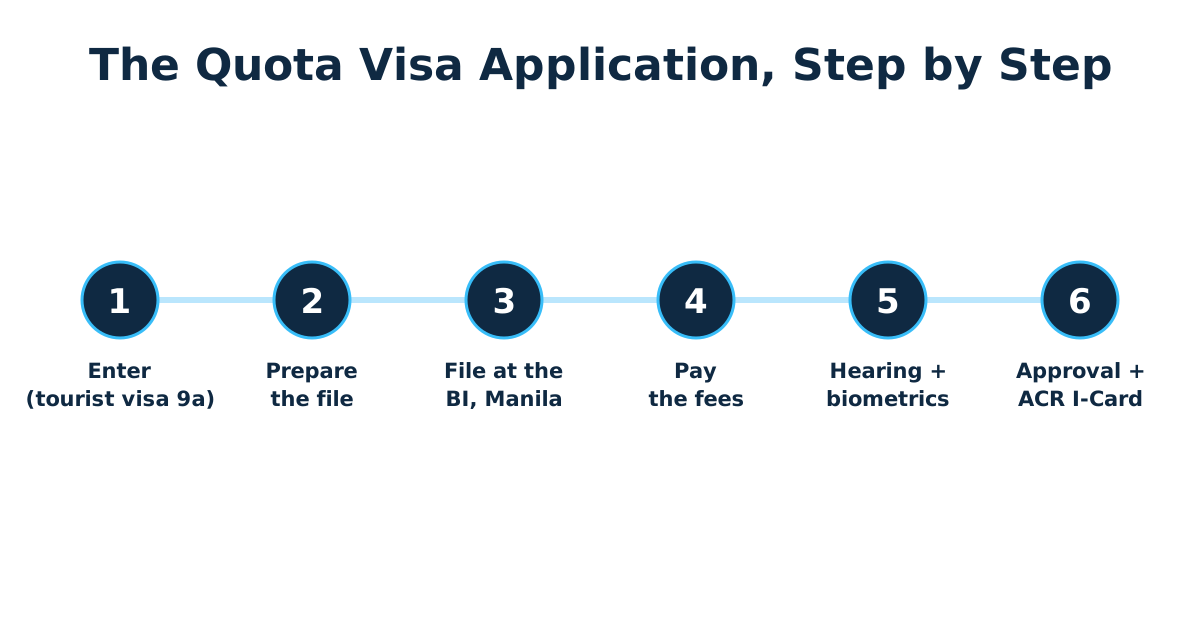
The Application, Step by Step
The quota visa is applied for inside the Philippines as a conversion from your current status:
1. Enter on a tourist visa (9a) or another valid status and settle your presence. Under current practice, plan for an extended stay before filing, not a fly-in-fly-out application.
2. Prepare the file: financial evidence, clearances, authenticated documents, CGAF.
3. File at the BI Main Office in Intramuros, Manila (or a designated BI office able to process the transaction). The Central Receiving Unit pre-screens the package; incomplete filings do not reserve a quota slot.
4. Pay the fees per the Order of Payment Slip.
5. Attend the hearing and the image and fingerprint capturing session. The schedule comes with your official receipt.
6. Await approval and receive your ACR I-Card. The visa is stamped, and you are a permanent resident.
Timelines vary with document verification and the BI's workload. A clean file typically moves in a few months; complications with foreign document authentication can stretch it toward half a year. While the application is pending you maintain your tourist status with ordinary extensions.
The 50-Slot Race
The cap is the defining feature, so understand its mechanics:
- •50 per nationality, per calendar year. Statutory, fixed, resets every 1 January.
- •No carry-over. Slots unused in one year vanish.
- •First to file wins. The BI dockets complete applications by date and time. An incomplete package does not hold your place.
- •Dual nationals elect one nationality for quota purposes.
How fast slots fill varies by nationality and year. Since the 2025 tightening and the SRRV's restructure pushed more people toward alternatives, demand has been strong. The rational strategy is simple: have your complete file ready before January and submit early in the year. This is precisely the kind of deadline logistics where having people on the ground matters; more on that below.
Spouse and Children
Your spouse and unmarried minor children can be included as dependents. Each dependent files their own quota visa form, with proof of relationship, health certification and BI clearance. If permanent residency for the whole family without a Filipino spouse is the goal, the quota visa is one of the very few ways to get there in a single application cycle.
What It Costs
Government fees follow the BI's current fee schedule and are itemized on your Order of Payment Slip at filing; budget for visa fees, the ACR I-Card, clearances, notarization and document authentication on top. The dominant financial factor is not the fees but the USD 100,000 capacity requirement, and whether you structure it as a remittance, a condo purchase or a business investment.
Quota Visa vs SRRV vs SIRV vs 13(a)
| Quota Visa | SRRV | SIRV | 13(a) | |
|---|---|---|---|---|
| Minimum age | 30 (current practice) | 40 | none | none |
| Marriage required | no | no | no | yes, to a Filipino citizen |
| Financial requirement | USD 100,000 capacity (remittance, condo or business) | deposit from USD 15,000, stays locked | USD 75,000 locked in listed shares or government bonds | none |
| Status | permanent resident (immigrant) | special resident (visa lives on the deposit) | special resident (visa lives on the investment) | permanent resident (immigrant) |
| Annual cap | 50 per nationality | none | none | none |
| Authority | Bureau of Immigration | PRA | BOI + BI | Bureau of Immigration |
The honest summary: if you're 40 or older and want the path of least resistance, the SRRV remains the workhorse. If you're younger, unmarried to a Filipino, and have USD 100,000 of committed capital, the quota visa gives you something neither special resident visa does: full immigrant status that doesn't depend on keeping money parked in a prescribed instrument. The price is the race for 50 slots and a more demanding file.
Taxes and Working
Permanent residency and tax residency are different questions. As a quota visa holder you become a resident alien for Philippine income tax purposes once you are physically present in the country for more than 180 days in a calendar year. Resident aliens are taxed on Philippine-source income. For how that interacts with your home-country situation, start with our tax page and get advice on your specific case.
For local employment you need an Alien Employment Permit from the Department of Labor, the same as other resident aliens. Running your own business, freelancing for foreign clients or living off investments involves no such permit.
FAQ
Is the quota visa really permanent, or does it expire?
It is permanent residency under Section 13 of the Immigration Act. There is no renewal cycle and no deposit to maintain. Your obligations are those of any permanent resident: the Annual Report each January and February, keeping your ACR I-Card current, and not committing deportable offenses.
Do I need to keep USD 100,000 in the Philippines forever?
The requirement is proof of financial capacity at application: an inward remittance certification, condo ownership or a qualifying business stake. It is not a lifetime locked deposit like the SRRV's. That said, the BI approves people it believes will sustain themselves here; gutting your Philippine footprint the day after approval is not the idea, and the BI can revisit misrepresentation.
Can I apply from abroad before moving?
Current practice favors applicants already in the Philippines, with reports of roughly 180 days of prior stay expected. Realistically you enter on a tourist visa, establish yourself, and file the conversion at the BI.
How do I know if my nationality's 50 slots are still open?
The BI doesn't publish a live counter. This is exactly what a local liaison checks before you file, and why complete files go in early in the year.
Does the quota visa lead to citizenship?
It counts toward the residence requirement for naturalization (generally ten years, reduced in specific cases). Most holders never naturalize because permanent residency already delivers what they need.
Is the quota visa cheaper than the SRRV?
In government fees, roughly comparable. In capital, it depends: the SRRV locks a smaller deposit for the visa's lifetime; the quota visa wants a larger demonstration of capacity but leaves you free to deploy it, including into the condo you'd live in.
Free guide
The Philippines: a flexible residence, a lighter tax bill and a better life
49 pages on visas, tax, banking, property and life in Davao City. PDF, straight to your inbox.
Our Commitment to You
The MyDavaoBase 7-Star Client Success Guarantee
Every client. Every package. No exceptions.