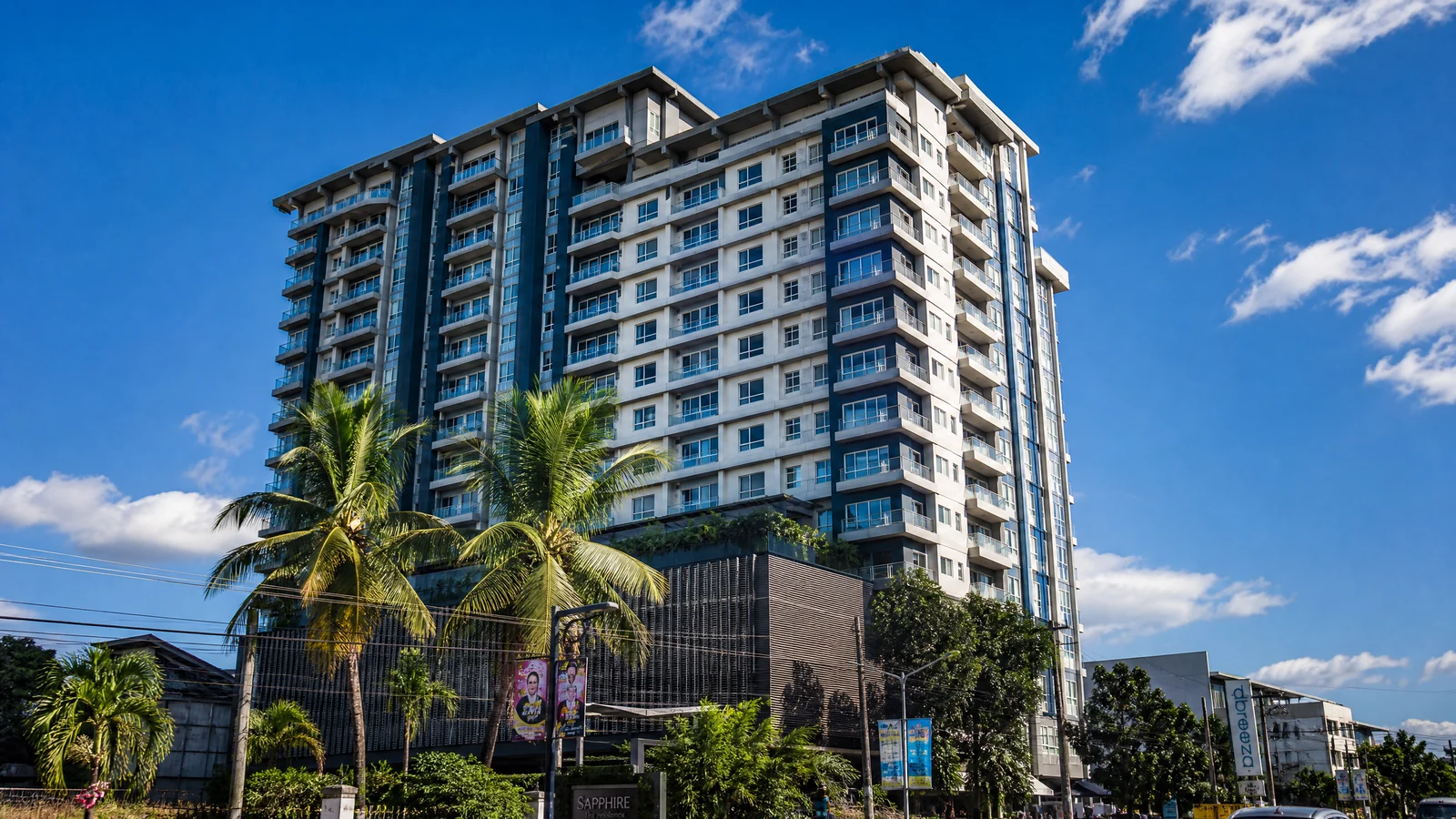
The short version fits in two sentences. You can buy a condominium in your own name, hold a real title, and pay a fraction of Western prices: good units in Davao start around $80,000. You cannot buy land: not directly, not through your Filipino spouse, not through a "trusted friend," and every structure promising otherwise is a trap with your money in it.
This page gives you the long version: the actual rules, real Davao prices by tier, the full cost stack, the legal alternatives for land, and the schemes to walk away from.
What you CAN own
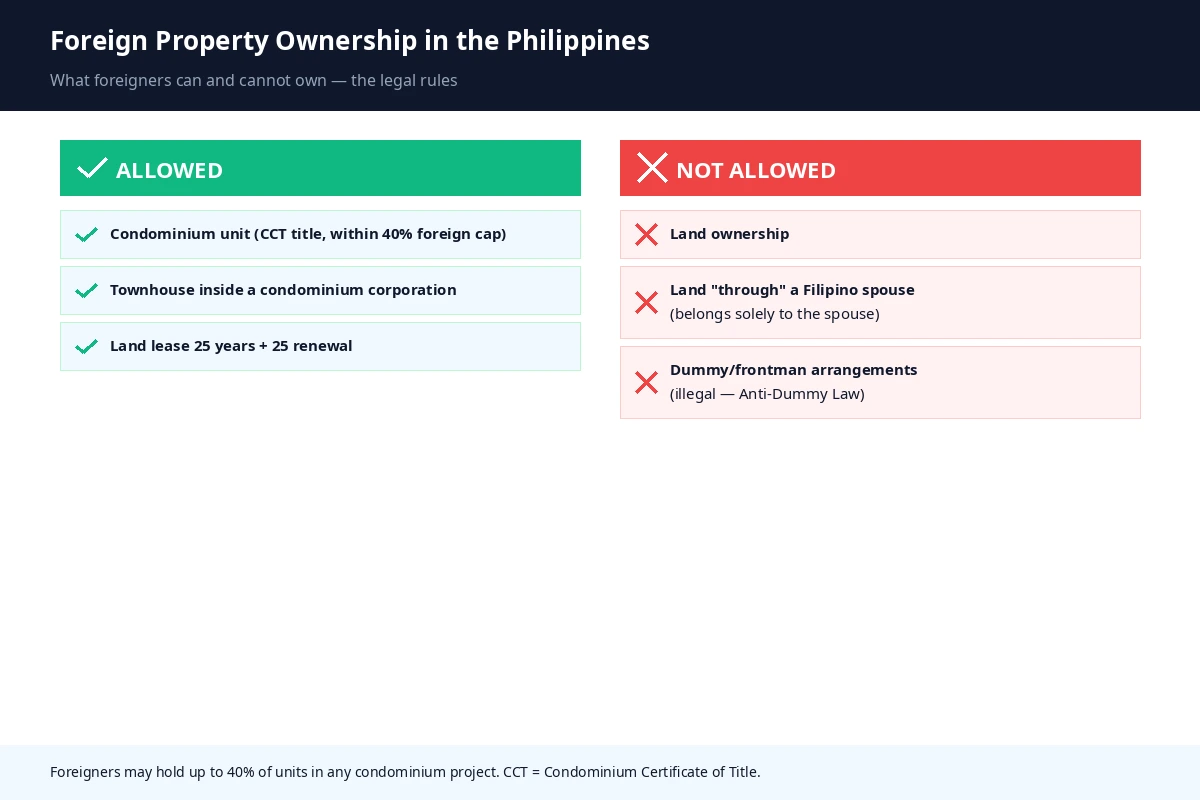
Condominium units: fully, in your own name. Philippine law allows foreigners to own condo units outright, as long as foreign ownership in the building stays within 40%. You receive a Condominium Certificate of Title (CCT): a real, registered title identifying you as the legal owner, transferable and inheritable. This isn't a leasehold workaround or a company sleight-of-hand; it's clean, constitutional ownership of the unit.
Townhouses: sometimes. Certain townhouses and row houses qualify *if* they're organized under a registered condominium corporation. The structure, not the shape of the building, is what matters. We verify this before you fall in love with a floor plan.
Long leases on land: the legal alternative. If your vision needs land (a standalone house, a garden), the lawful route is a lease of up to 25 years, renewable once for another 25. Fifty years of documented control without fighting the constitution.
What you need to buy: a valid passport and a Philippine TIN for the transaction. Notably, *no* residency visa is required. Though the TIN is one more reason the base-building sequence starts where it does.
What you CANNOT own, and the traps built around it
Land. Full stop. The constitutional restriction doesn't bend, and the two "solutions" the internet sells both fail:
- •"Buy through your Filipino spouse." You can't co-own land with your spouse: The land belongs exclusively to them. That may be a perfectly fine family decision made with open eyes (the 13A page covers planning ownership deliberately), but it is not *you* owning land, and treating it as such has ended badly in enough separations and inheritances to fill a case-law library.
- •Dummy arrangements: a Filipino frontman holding title "for" you, side agreements in a drawer. Illegal under the Anti-Dummy Law, unenforceable by design, and the perfect crime against yourself: if it goes wrong, you can't even sue on the agreement that was never allowed to exist.
Our rule for clients is absolute: if a structure only works while nobody looks at it, we don't build it. The legal menu (condo, condo-corp townhouse, 25+25 lease) is genuinely sufficient for almost every real need.
Davao prices: the honest tiers
Entry: ₱3–5 million (~$52,000–88,000). Studios and compact two-bedroom units, 30–50 m², in established developments in Ecoland or Maa. Older buildings, solid bones, the cheapest real title money buys here.
Comfortable: ₱5–10 million (~$88,000–175,000). Two to three bedrooms, modern fit-out, AC, pool and security: One Oasis, Camella Northpoint, Abreeza Place territory. The tier most foreign buyers actually choose.
Premium: ₱10–25 million (~$175,000–440,000). Aeon Towers, Dusit Thani Residences: concierge, gyms, panoramas, central addresses. Davao's ceiling, at prices that wouldn't buy a parking space in Zurich.
Here is what that looks like in practice: real example condos, selected by our own team.
The full cost stack
The sticker price isn't the whole price. Budget for:
- •Closing costs: roughly 3–5% of the purchase price: notarial fees, documentation, transfer and registration. Payable around completion, not financeable into the price.
- •Annual property tax: about 1–1.5% of assessed value, location-dependent: a few hundred dollars a year at the entry tier, not a Western-style burden.
- •Condo dues: ₱2,000–10,000 monthly (~$35–175) depending on building and amenities. The pool and the guards live in this line.
- •If renting it out: Philippine-source rental income is taxable here: Plan the tax side before the tenant, not after.
Pre-selling vs resale: Davao's two markets
Davao's condo market really is two markets, and they reward different buyers. Pre-selling (buying off-plan from the developer, often years before turnover) comes with lower entry prices, stretched payment schedules, and the pick of units and floors. Its risks are equally structural: you're buying a promise, so the developer's track record *is* the product, delivery dates slip, and the unit you visualized meets reality only at turnover. Resale costs more per square meter but hands you certainty: the building exists, the dues history is inspectable, the view is the view, and turnover is measured in weeks. Our rule of thumb: resale for anyone buying their own residence on a near-term timeline; pre-selling only with a developer whose completed projects we can walk through, and only for buyers who can treat the timeline as flexible. In both markets, the verification step is where we earn our fee, pre-selling especially, where the contract's fine print on delays and alterations deserves adult supervision.
The 40% cap in practice
The foreign-ownership cap sounds abstract until it isn't: popular buildings in expat-heavy cities can run close to their limit, and a sale to you only registers if the building has headroom. Practically this means the cap check comes *first*, not at closing: We confirm the building's current foreign quota with the condo corporation before you negotiate, because discovering a full quota after agreeing a price wastes everyone's month. The cap also shapes resale value in your favor: units in well-run buildings with headroom trade at a premium among foreign buyers precisely because they're eligible. It's one of those rules that punishes the unprepared and quietly rewards buyers who do the homework, which is to say, it's our favorite kind of rule.
Buy or rent? The honest framework
We sell property support, and we'll still say it plainly: most newcomers should rent first. A year of renting costs a fraction of a wrong purchase, teaches you the districts, and does identical residency-paperwork duty. Buying earns its place when: you know the city and your district, you're holding a 5+ year horizon, you want to convert rent into equity at prices that make the math easy, or the SRRV deposit-to-condo conversion fits your plan. What buying does *not* do: land is never part of it, and a condo purchase confers no visa: Ownership and residency are separate tracks that merely reinforce each other's paperwork.
How a purchase runs with us
- 1
Brief and shortlist
Tier, district, new-build vs resale, through our vetted broker network (the same one behind our rental search).
- 2
Verification
The unglamorous part that matters: title check on the CCT, the building's foreign-ownership headroom under the 40% cap, developer track record on pre-selling projects, dues and arrears status.
- 3
Negotiation and contract
Price, terms, and a contract reviewed by local counsel before any money moves.
- 4
TIN and payment logistics
Your TIN for the transaction, funds routed properly through banking channels with a clean paper trail.
- 5
Title transfer and registration
Through to the CCT in your name, followed by utilities and, if you wish, our management service running the unit.
Frequently Asked Questions
Is pre-selling safe?
It can be: with an established developer whose finished buildings you can inspect, a contract reviewed before signing, and a timeline you can afford to see slip. It's the wrong market for anyone who needs certainty on price, date and view; that buyer belongs in resale.
Can foreigners really own property in the Philippines?
Yes: condominium units, outright and titled in your own name (CCT), within the 40% foreign-ownership cap per building. What foreigners cannot own is land, in any structure.
Can I buy land together with my Filipino spouse?
No: Land titled during marriage to a Filipino spouse belongs exclusively to them. That can be a legitimate family plan, but it isn't foreign co-ownership, and dummy workarounds are illegal.
What does a decent condo in Davao cost?
Entry units start around ₱3–5M (~$52–88k), the comfortable tier runs ₱5–10M (~$88–175k), premium towers ₱10–25M (~$175–440k). Add 3–5% closing costs.
Do I need a visa to buy?
No: A passport and a Philippine TIN suffice for the transaction. Residency and ownership are separate tracks.
What are the running costs?
Annual property tax around 1–1.5% of assessed value plus monthly condo dues of ₱2,000–10,000, building-dependent. Rental income, if any, is Philippine-source and taxable.
Can I finance the purchase locally?
Local mortgage lending to foreigners exists but is conservative: Expect meaningful down payments, and residency status plus local banking history materially improve terms. Most foreign buyers here purchase in cash or finance abroad; we'll map the realistic options against your profile before you shortlist.
Where can I browse listings myself?
Lamudi, DotProperty and Property24 give a fair market picture, with peso and sometimes euro pricing. For actual transactions we work through vetted brokers and verify title, cap headroom and developer standing before you commit.
Free guide
The Philippines: a flexible residence, a lighter tax bill and a better life
49 pages on visas, tax, banking, property and life in Davao City. PDF, straight to your inbox.
Our Commitment to You
The MyDavaoBase 7-Star Client Success Guarantee
Every client. Every package. No exceptions.