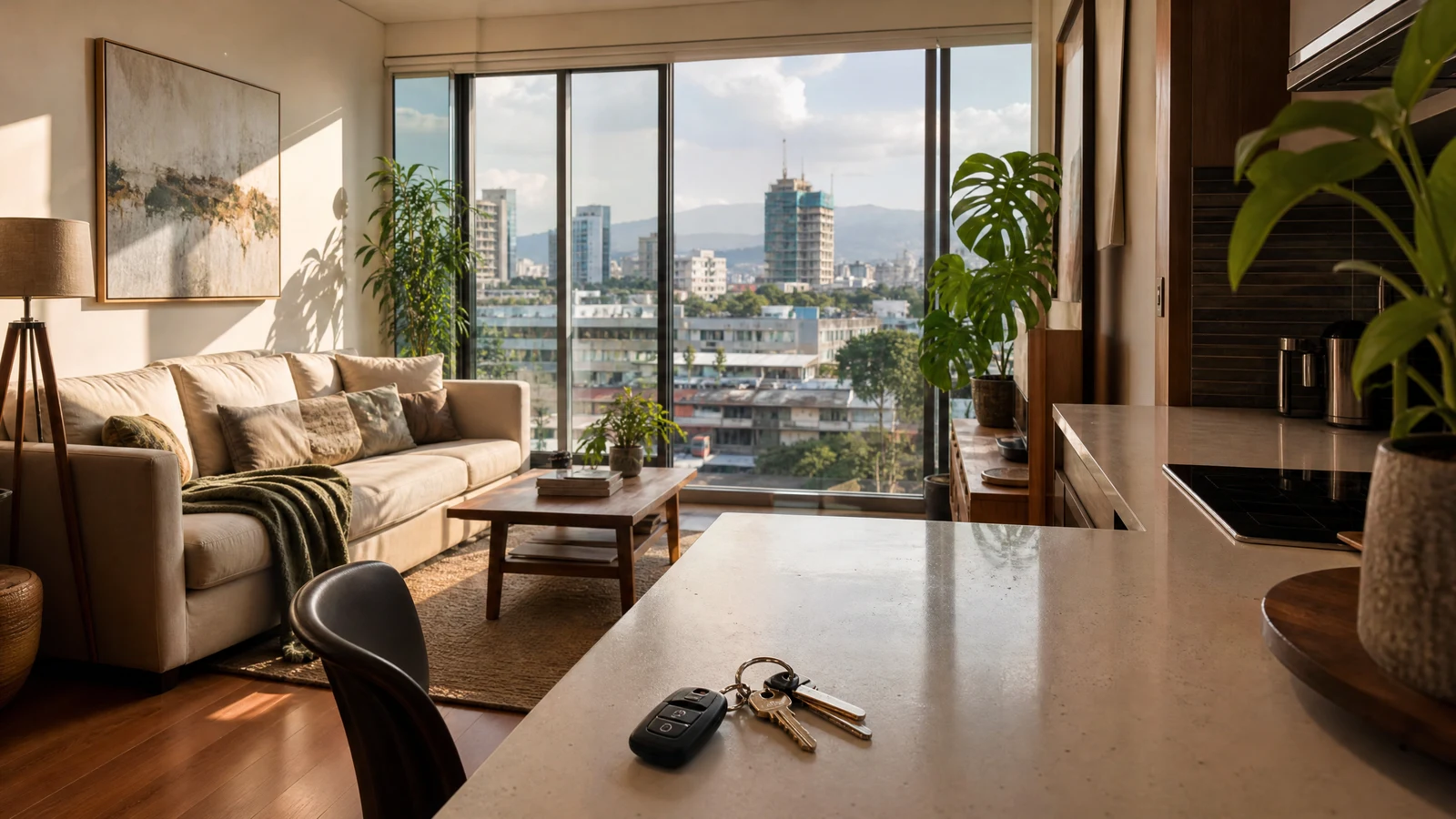
Here's a number that recalibrates people: a good, fully furnished apartment in a secure Davao development (pool, gym, 24-hour guards) rents for less per month than one night in a decent hotel in a Western capital. That's not a slogan; it's the arithmetic that makes the entire relocation model work, and this page gives you the real figures behind it.
But price is the second most important thing on this page. The first: in our model, your lease is not just housing: It's the cornerstone of your residency. The rental contract in your name is the document that anchors your TIN application, your BIR registration, your bank account, your ACR I-Card, and ultimately your tax residency. Choosing a rental in Davao is choosing the foundation of your paperwork. So let's do it properly.
What rentals actually cost
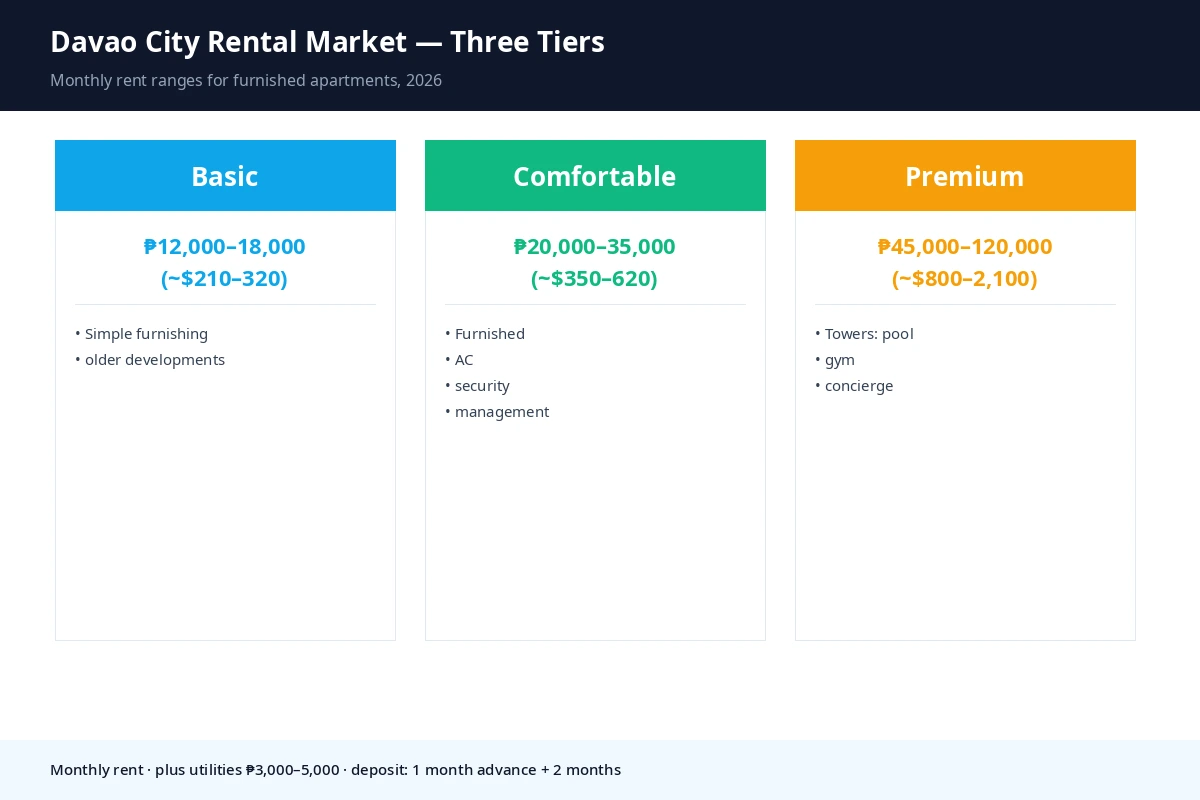
Davao's rental market runs on three broad tiers. Figures are monthly, in pesos with dollar approximations. Treat the dollar figures as orientation, not quotes:
Basic: ₱12,000–18,000 (~$210–320). Simple furnishing, essential appliances, older developments or peripheral districts. Clean and livable by local standards: no luxury, no drama. Example: a two-room unit in a Lanang-area village development at around ₱15,000.
Comfortable: ₱20,000–35,000 (~$350–620). The expat sweet spot: modern furnishing, air conditioning, reliable internet, property management, security. Developments like One Oasis (Ecoland) or 8 Spatial (Maa) define this tier; a fully furnished unit at the top of the range runs about ₱35,000.
Premium: ₱45,000–120,000 (~$800–2,100). Designer interiors, elevators, pools, gyms, concierge, 24-hour security: Aeon Towers, Dusit Thani Residences, Abreeza Place. An executive two-bedroom at Dusit Thani tops the market around ₱120,000, and still costs less than a mid-tier one-bedroom in most Western cities.
Most of our clients land in the comfortable tier and are genuinely surprised how far it goes. The premium tier exists for those who want it, not because you need it to live well here.
Here is what that looks like in practice: real example properties, photographed by our own team.
The neighborhoods that matter
Four districts cover most foreign residents' needs: Ecoland (central, established, close to malls and the airport road), Bajada (city-center energy, walkable to offices and hospitals), Maa (quieter, residential, good value), and Lanang (north side, near SM Lanang and international schools, popular with families). The right choice depends on your daily pattern (clinic proximity for retirees, school runs for families, coworking distance for remote workers) and it's the first question we ask, not the last.
The mechanics: deposits, utilities, contracts
- •Move-in cost: the standard structure is one month's rent in advance plus two months' deposit: Budget three months' rent to get keys.
- •Utilities: typically *not* included. Plan on ₱3,000–5,000 (~$55–90) monthly for electricity, water and internet. Air-conditioning habits are the swing factor.
- •Contract form: a proper written lease, in your name, with the owner's details: This is non-negotiable in our model, because an informal arrangement can't anchor a TIN application or satisfy a bank. The lease is a legal document doing residency work.
- •Pest control: ask whether the building runs a regular program: standard question in the tropics, and buildings that do it well say so proudly.
- •Security: gated communities and guarded condos are the norm at the comfortable tier and above, one of the reasons Davao's famous orderliness extends to daily life at home.
Furnished, semi-furnished, bare: decode the listings
Philippine listings use three terms worth decoding before you compare prices. Fully furnished means move-in ready: beds, sofa, appliances, usually down to plates: the standard at the comfortable tier and the right choice for anyone starting a base. Semi-furnished typically means air-conditioning units and kitchen built-ins but no loose furniture: The price looks attractive until you've bought a household. Bare is exactly that, common in local-market listings and rarely right for a foreign resident's first year. When comparing across tiers, normalize for this: a ₱22,000 fully furnished unit routinely beats a ₱17,000 semi-furnished one on true first-year cost. And one Davao-specific note: because turnover in the popular expat buildings is steady, genuinely good fully furnished units move within days, which is why we shortlist from broker feeds rather than public portals, where the good ones are often gone by the time they're photographed.
A note on renting as your Plan B
Not everyone reading this is moving next month. If you're building a base in reserve (the Plan B model), the rental question changes shape: the apartment's job is to exist, be documented, and cost little while it waits. The basic and lower-comfortable tiers shine here: a real, formally leased unit at ₱15,000–20,000 is a rounding error annually, and it does the same paperwork duty as a penthouse. Combined with our management service (checks, mail, upkeep), plenty of clients run exactly this: a modest, real, monitored apartment whose lease anchors their Philippine documentation years before they need to use it in anger. The one thing we won't do is fake it (no mailbox setups, no address-only arrangements), because a base that can't survive a knock on the door isn't a base.
The five rental mistakes foreigners make
- 1
Renting on a handshake
Cheaper this month, useless forever: no lease means no TIN anchor, no bank evidence, no residency documentation. Pay the formal-contract premium; it's buying paperwork that works.
- 2
Signing sight-unseen from abroad without representation
Photos age well; buildings don't always. If you can't view, someone you trust must: This is precisely what our team does before you commit.
- 3
Ignoring the internet question
For remote workers, fiber availability is a harder requirement than the pool. Verify the building's actual provider options, not the listing's "high-speed WiFi" claim.
- 4
Optimizing purely on price
The ₱6,000 saved on a peripheral unit gets consumed by transport, generator gaps and inconvenience. The comfortable tier earns its price in infrastructure.
- 5
Letting the lease lapse quietly
Renewals matter beyond housing: a continuous lease history is continuous residency evidence. We calendar it alongside visa deadlines for exactly that reason.
Rent against the alternative: the hotel-and-Airbnb trap
A pattern we see often enough to name: newcomers park in serviced apartments or Airbnbs "until they know the city", at ₱60,000–100,000 a month for what the comfortable tier delivers at ₱30,000, while generating zero residency paperwork. Two months of that costs more than a year's difference between rental tiers, and at the end you hold receipts a bank can't use. The better sequence: a short hotel landing (days, not months), the lease signed early, then explore the city from a base that's already doing documentation work. If you later want to move districts, Davao leases are typically one-year terms and re-renting is cheap; the first lease's paperwork value survives the move, because the history is what counts.
How we run the search
You tell us the brief: budget, tier, district priorities, move-in window. Our team shortlists from broker contacts and direct-owner listings, walks the units (video for you if you're abroad), negotiates terms, and reviews the contract before you sign. You can be here for it, but you don't have to be: Plenty of clients sign their Davao lease from Frankfurt or Denver and arrive to a working apartment. And once you're in, our ongoing management service keeps the place monitored, the mail forwarded, and small repairs handled while you travel: the answer to "what happens to my apartment when I'm not there?" is: nothing you'll need to think about.
Frequently Asked Questions
How does the apartment search work with your team?
Brief → shortlist → viewings (in person or by video) → negotiation → contract review → keys. We run the process end to end through our local broker network; you decide, we execute.
What does a good expat apartment really cost?
The comfortable tier (₱20,000–35,000, ~$350–620 monthly) covers modern, furnished, secure living in the popular developments. Basic starts around ₱12,000; premium towers reach ₱120,000.
What happens to my apartment when I'm traveling?
Our management service checks the unit regularly, receives and forwards mail, and handles small repairs: Your base stays functional whether you're gone two weeks or two months.
Do I need to be in Davao to rent?
No: Search, viewing and signing can all be handled remotely through us. Many clients secure the lease before their first flight, precisely so the residency paperwork can start immediately.
Is the lease really that important for residency?
Yes: It's the anchor document. TIN, BIR registration, bank account and ACR I-Card all reference your address; without a formal lease in your name, the paper trail has no foundation.
Are utilities and deposits standard?
Expect one month advance plus two months' deposit at signing, and ₱3,000–5,000 monthly for utilities on top of rent. Both are market-standard and negotiable only at the margins.
Free guide
The Philippines: a flexible residence, a lighter tax bill and a better life
49 pages on visas, tax, banking, property and life in Davao City. PDF, straight to your inbox.
Our Commitment to You
The MyDavaoBase 7-Star Client Success Guarantee
Every client. Every package. No exceptions.